Reading Your Ethnicity Estimate
Remember when you got your AncestryDNA test results? You likely recall the anticipation, the excitement of what you might discover—and the fun of sharing your results with family.
But people often don’t realise how much information is contained in their results. Your ancestral regions report (commonly known as an ethnicity estimate) actually has two major pieces of information:
Ancestral regions are the most well-known part of the report and come with percentages, like 25% Sweden or 10% Senegal. This part of the report can point to ancestral origins in a place as far back as 20 generations ago or further.
Regions are based on genetic relationships among groups, which means they often don’t fall neatly along modern political borders. To help organize regions and highlight relationships between them, regions are now grouped by macro-regions. Macro-regions are broader labels defined by geography or population (e.g., "England" or "Celtic & Gaelic"). Macro-regions are not a by-product of our analysis of your DNA and do not have a percentage associated with them.
This portion of the report does not have assigned percentages. Instead, ancestral journeys represent potential paths taken by people who likely descend from a group of people with a common history and share many matches.
Looking at your journeys results can give you a more granular understanding of where your ancestors may have come from—sometimes down to the region of a country or even a county. These results also reflect the more recent past, about 5-20 generations ago.
How Does AncestryDNA Assign Ancestral Regions?
Assigning ancestral regions based on your DNA is a complex process. It’s based on probability, statistics, and shared DNA. Here’s a closer look at how Ancestry scientists approach the topic of regions.
First, our scientists create a reference panel, which is made up of reference groups. Each reference group has the DNA of people whose family lived in a certain part of the world for many generations. Each reference group represents a particular region.
Since 2025, more than 140 reference groups have been included in the AncestryDNA reference panel.
When a customer takes an AncestryDNA test, our scientists compare their DNA, piece by piece, to see which reference group each piece of that customer’s DNA most closely resembles. The regions assigned to each piece of DNA are then totalled up and the percentages are calculated. If 15% of the DNA pieces analysed look most like the France reference group, then the customer gets 15% France in their report.
AncestryDNA continues to add samples and update its reference groups to improve precision and include additional ancestral regions in AncestryDNA test results. Also, AncestryDNA may update the way it analyses your DNA as the technology becomes more precise.
Updating our reference groups and the way we analyse your DNA means that over time your results may also be updated.
What Are SNPs and How Are They Key to Your Report?
To determine the ancestral regions in your report, an AncestryDNA test looks at about 700,000 markers in your DNA. Those markers are called SNPs (pronounced “snips”). SNPs are common and shared genetic variants at specific sites in DNA, where one nucleotide letter in your DNA is commonly substituted for another.
For example, the SNP called rs122 could occur at the 1,000 base position on chromosome 1. At that position, some people may have an A in their DNA, and others may have a C. Because you get one letter (or allele) from each biological parent, your genotype could be AA, AC, or CC.
Each possible outcome at each SNP has a probability for how likely it is to show up in each region represented by the reference panel. We’ll pretend that rs122 occurs at the following frequencies in the populations Ancestry defines as Mexican and Spanish:
A = appears 5% of the time in Mexican populations and 75% in Spanish populations.
C = appears 95% of the time in Mexican populations and 25% in Spanish populations.
So, if you have AA at rs122, it’s more likely that this specific part of your DNA is Spanish than Mexican. If your DNA reads CC, then the opposite is more likely.
One SNP doesn’t tell us much about your ancestral origins, but when we apply the same process to thousands of SNPs, and then do the math, the total becomes the basis for your results.
Why Do Ancestral Regions Have a Range of Percentages and How Is it Determined?
In addition to the most likely estimate, our algorithm also generates 1,000 likely estimates using the probabilities learned from comparing your genetic data to our reference panel.
We use these 1,000 likely estimates—which may be different from the most likely estimate—to figure out the range. The way we calculate the range depends on the region and the value of the most likely estimate.
Here’s an example of AncestryDNA results for someone with strong ties to the Americas.
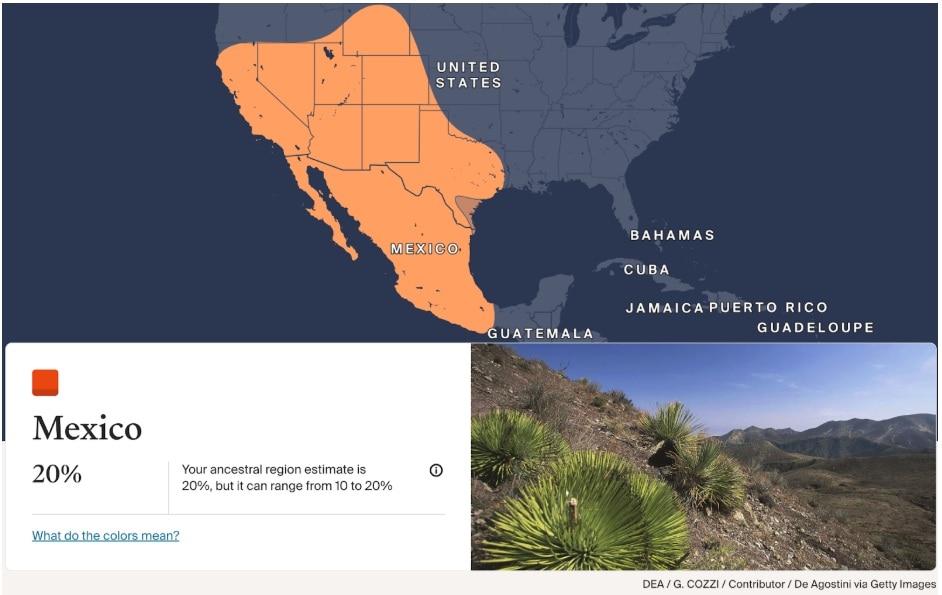
In the example above, between 10% and 20% of this customer’s DNA appears to match the Mexico reference panel, with the most likely percentage being 20%. To find out your range of likely percentages for a region, click on the region in your results.
These ranges are important to look at, especially for results with lower percentages. In these cases, the range can sometimes include zero. This means it is possible that your ancestors didn’t live in that region or you didn’t inherit any DNA from ancestors who did.
But My Family Never Lived in [Your Mystery Region Here]?
So how do you interpret your report shows that 7% of your DNA is from Southern Wales, for example, and you’ve never heard of anyone in your family being from Wales? This is where the maps and the polygons drawn on top of them can help.
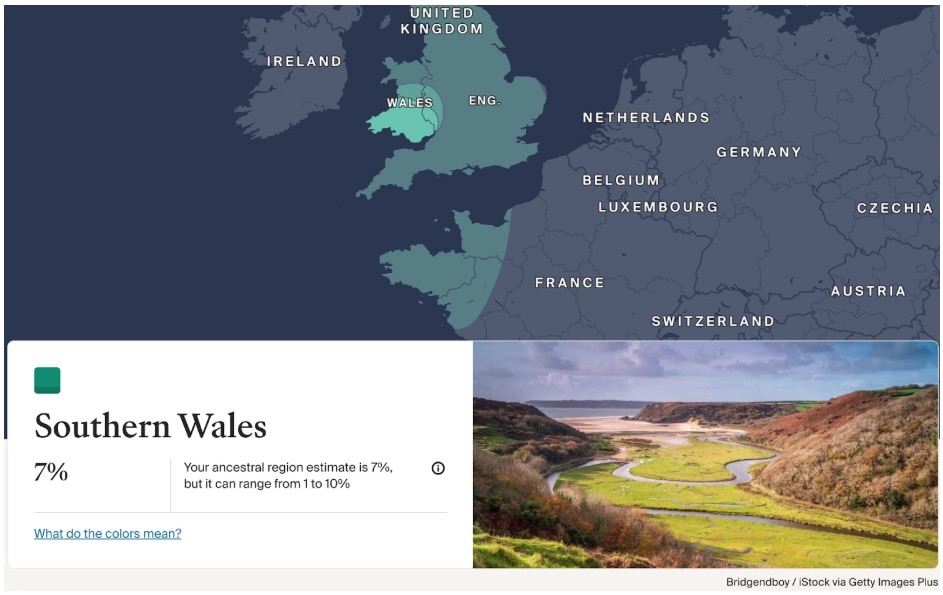
By clicking on Southern Wales, the first thing you'll notice is that this ancestral region is found throughout Wales, as well as in England and France. These areas are highlighted in the polygons on the map. So, already there are new possible places the ancestor who passed this down might be from.
These drawn shapes make sense because shared genetic history doesn’t always match modern national borders. Throughout the ages, as people crossed borders we see on the map today, they took their DNA with them. For example, in the 5th and 6th centuries, many British Celts fled from the Anglo-Saxon invasion of Briton and settled in Brittany.
So, your ancestral regions results can provide insight not only on where your ancestors might have lived but also allow you to trace the path of your ancestors.
Why Do My Results Differ From My Family Story?
Your genetic results tell you about your possible historical origins, not necessarily about where you live today. AncestryDNA® genetic results go back hundreds to more than a thousand years, when populations and the boundaries they claimed were often very different. This might lead to different genetic results than you expect.
While someone’s language, name, or culture may change when they move to a new location, their DNA doesn’t. This can lead to surprises in your report. For instance, if your Italian grandmother had ancestors who migrated from Eastern Europe hundreds of years ago, your results might include the Eastern European region rather than an Italian region.
The opposite can also happen. DNA is passed down randomly and the amount of DNA you inherit from any particular ancestor decreases with each generation. That means you can have an ethnicity you know of in your family history that doesn’t show up in your results.
If you haven’t looked at your ancestral regions in a while, go back and give them another look. You’re much more than a pie chart and a handful of percentages. And so is your AncestryDNA origins report.


Related articles

Polygenic Risk Score
An AncestryDNA® Traits test can tell you whether you're more or less likely to be an introvert or extrovert, to have the sprinter gene, or if your aversion to cilantro is based in genetics.

AncestryDNA® Test Accuracy and Precision
Your AncestryDNA® test results are the product of a multi-step process. There is no single measure of AncestryDNA® test accuracy. Instead, the accuracy and precision of each step can be measured independently.

Heritability
It’s easy to look at the people around us and see how much variation there is in physical appearance and behaviour. But, how much of this variation is nature versus nurture? Scientists in the fields of quantitative genetics and social sciences look for answers by studying heritability.