Cousins Chart and Centimorgans
Once you’ve received your AncestryDNA test results, you’ll be able to see how you’re genetically connected to others—people with whom you share pieces of DNA. Your AncestryDNA matches are automatically labeled with a description of how someone is related to you.
Knowing this information can help you build out your family tree. You may discover previously unknown second, third, or fourth cousins, as well as more distant relatives. If you were adopted, you may find clues about your genetic birth family in the DNA test results.
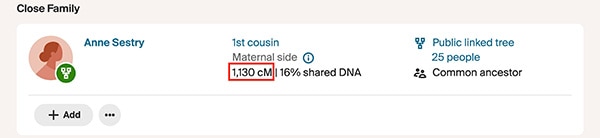
Your test results will indicate the exact number of centimorgans (cM) you share with a DNA match. But when you see something like “742 cM” being used to describe your connection to someone, do you understand what that means? Learning more about centimorgans can help you know how you’re genetically related to someone else.
What Is a Centimorgan?
We often use centimorgans (cM) to talk about an amount of DNA. Simply put, the more centimorgans of DNA you share with someone, the more closely related you are to them.
But, the real story is more complicated. A centimorgan actually refers to the process of recombination and DNA inheritance. Bottom line, centimorgans can accurately be used as a measure of length or amount of DNA.
The centimorgan is named after Thomas Hunt Morgan, an American geneticist who received a Nobel Prize for his discoveries about the role played by chromosomes in heredity.
How Many Centimorgans Do Humans Have?
In total, each human has about 6,000-7,000 centimorgans. There is no set number of centimorgans of DNA for humans because centimorgans actually measure the probability of recombination, not the physical number of base-pairs in the DNA. It turns out that the frequency of recombination is, on average, higher in females than in males. This means the genomes of females tend to be “longer” in terms of centimorgans than the genomes of males.
When viewing your AncestryDNA matches, the number of centimorgans we report you share with a match is our estimate of the amount of shared DNA we can attribute to a recent common ancestor. To learn more about why sharing DNA doesn’t always mean sharing a common ancestor, see our Support Center article. For more details about how AncestryDNA looks at centimorgans, read our white paper.

How Centimorgans Explain Second, Third, and Fourth Cousins: Understanding DNA’s Role in Determining Relationships
Viewed through a DNA lens, family connections are all about how much DNA (measured in centimorgans) you share with another person. Close family members—parents, siblings, aunts and uncles, and first cousins—share the highest number of centimorgans, which makes it easier to identify and name their connection to you.
Keep these points in mind when reviewing your DNA test results, as they can explain why you’ll see variations in the number of shared centimorgans.
- Each biological parent passes along a random half of their DNA to their child, which is why only identical twins have the same DNA. While siblings inherit DNA from both parents, they don't inherit exactly the same halves. This is why the number of centimorgans siblings share with each other can vary between sibling pairs.
- The random nature of genetic inheritance is also why you might share slightly more (or less) DNA with a particular cousin.
- The amount of DNA you inherit from any particular ancestor decreases with each generation.
When you get beyond close family members, the relationship you have to another person, based on the number of shared centimorgans, can become complicated for several reasons:
- A grandparent or great-grandparent who had more than one spouse, and who had children with those different spouses, produced children who are half siblings. Those half siblings don’t share the same range of centimorgans that full siblings do. When half siblings have children, it becomes even more difficult to assign them a relationship description based on shared DNA. This complication gets further compounded over generations.
- If any of your ancestors came from a culturally or geographically isolated group of people who tended to have children with others in that same group over many generations, that can impact the shared DNA segments (and centimorgans) in subsequent generations. Generally, members of these groups will share more DNA with each other than expected based on their genealogical relationship.
These are some of the reasons why you might see a label in your DNA match list that says “2nd cousin or half 1st cousin 1x removed” or “4th cousin or half 3rd cousin 1x removed.”
Centimorgan Chart and Insights
While general ranges of centimorgans are associated with different family relationships, some relationships, like a first or second cousin, appear in multiple ranges due to the random nature of DNA inheritance. This is because we don’t always inherit DNA from ancestors in exactly the expected amounts (like 25% from each grandparent or 12.5% from each great-grandparent). Especially as relations become more distant, the range of expected shared DNA broadens.
| DNA relationship | cM range (how much DNA you may share) |
|---|---|
| Parent/child | More than 3,300 cM |
| Sibling (full); in rare cases, a half-sibling who’s also your first cousin might also show up in this category. | 2,200–3,300 cM |
| Half sibling; aunts or uncles; nieces or nephews, grandparent or grandchild; great-grandparent or great-grandchild *It’s possible, but rare, for someone in this category to be a first cousin |
1,300–2,200 cM |
| First cousin; second cousin; half first cousin; great-great-grandparent or great-great-grandchild; great-aunt or -uncle; great-niece or -nephew; great-great grandparent or great-great-grandchild; first cousin once removed; great-great aunt or uncle; great-great-niece or nephew; half aunt or uncle; half niece or nephew | 340–1,300 cM |
| Second cousin; half first cousin once removed; first cousin twice removed | 90–340 cM |
| Second cousin; second cousin twice removed; third cousin; first cousin twice removed; half second cousin; first cousin three times removed; second cousin once removed; third cousin once removed | 65–90 cM |
| Fourth cousins and beyond could represent many different types of distant relationships. You’ll usually share about 20–85 centimorgans with a 4th cousin and 6–20 centimorgans with a 5th through 8th cousin. | 6–85 cM |
While centimorgans can identify distant relatives, they’re unlikely to be closer than six degrees of separation from you. Distant relatives will share less DNA with each other, making it harder to predict how you’re related. You may, in fact, find you share no DNA. This is one reason why your genealogical family tree can look different from your DNA family tree.
What Does it Mean When a Cousin Is “Once Removed”?
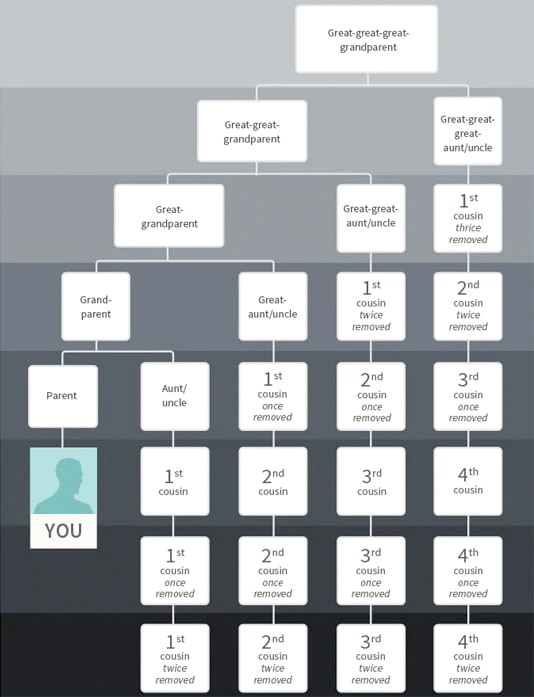
You’ll see in your DNA test results that some people are described as “removed.” This label refers to the generational difference between you and the other person. Figuring out how you’re related to a cousin involves “counting back” through the generations to see how you’re connected. Your parents are one generation back, your grandparents are two generations back, and so on.

- First cousins, second cousins, and so on belong to the same generation as one another, counting back the same number of generations to their shared ancestors.
- If your cousin is a generation older or younger than you, we use the term “removed” because you’re one generation apart.
- If your cousin counts back three generations while you count back five, then you would be second cousins twice removed. The “second” would be due to the number of generations back your cousin counted to a common ancestor, and “twice removed” thanks to the difference in generations between you.
Cousin Chart: Your Extended Family Explained
As you build your family tree using DNA matches, keep in mind that a certain range of centimorgans can point to different types of family relationships. But those clues, combined with the concept of “once removed,” for example, can help you start to piece together the complex picture that makes up your genetic family history.
Whether you share 3,000 cM, 500 cM, or 15 cM with someone, you each carry different pieces of your family’s DNA history. Understanding your connections to different DNA matches through an AncestryDNA test can provide you with a richer, fuller understanding of your family’s story.


Related articles

Heritability
It’s easy to look at the people around us and see how much variation there is in physical appearance and behaviour. But, how much of this variation is nature versus nurture? Scientists in the fields of quantitative genetics and social sciences look for answers by studying heritability.

Polygenic Risk Score
An AncestryDNA® Traits test can tell you whether you're more or less likely to be an introvert or extrovert, to have the sprinter gene, or if your aversion to cilantro is based in genetics.

DNA Sequencing
We choose the 700,000 DNA markers to look at specifically to be most informative about your DNA matches, genetic ethnicity, and predicted traits.